How to Improve Your SaaS Activation Rate: 8 Fixes, Answer First
Tarun · 15 November 2026 · 8 min read
Quick answer: to improve your SaaS activation rate, pick one milestone that proves a new user got value, measure how many signups reach it, then remove every step between signup and that milestone that isn't needed. After that, guide the steps that remain with a short checklist, make finishing them worth something, and compare weekly signup cohorts so you know which change moved the number. The rest of this guide is those eight fixes, in the order worth doing them.
Your SaaS activation rate is the percentage of new users who complete a critical action or milestone — in practice, the share who hit an aha moment during onboarding.
What is a good SaaS activation rate?
In published vendor benchmarks, a typical SaaS activation rate sits somewhere around 25% to 37.5%, depending on the source and whether you read the median or the average. The spread by product type is wide, so compare yourself mainly against your own past cohorts.
The formula is one line:
Activation rate = activated users ÷ total signups × 100
Count both numbers over the same signup period, or the rate drifts.
For benchmarks, you have two useful sources. Userpilot's 2025 benchmark report of 62 companies puts the average activation rate at 37.5%. The same report shows how wide the spread is: AI/ML products average 54.8% while FinTech averages 5%, and product-led companies sit around 34.6% against 41.6% for sales-led ones. A Lenny Rachitsky survey cited by Navattic found an average of 34% and a median of 25%.
Both are vendor data, so treat any activation rate benchmark as a rough guide, not a target. Your own trend, measured the same way every week, matters more than the gap between you and a report.
How to improve SaaS activation rate: eight fixes
The eight fixes, in order:
- Pick one aha milestone.
- Measure time to value, not just the rate.
- Map the path and find the biggest drop-off.
- Cut steps that don't lead to the milestone.
- Guide what's left with a short checklist and progress.
- Reward completion with your own product credits.
- Segment milestones by user type.
- Measure weekly cohorts and change one thing at a time.
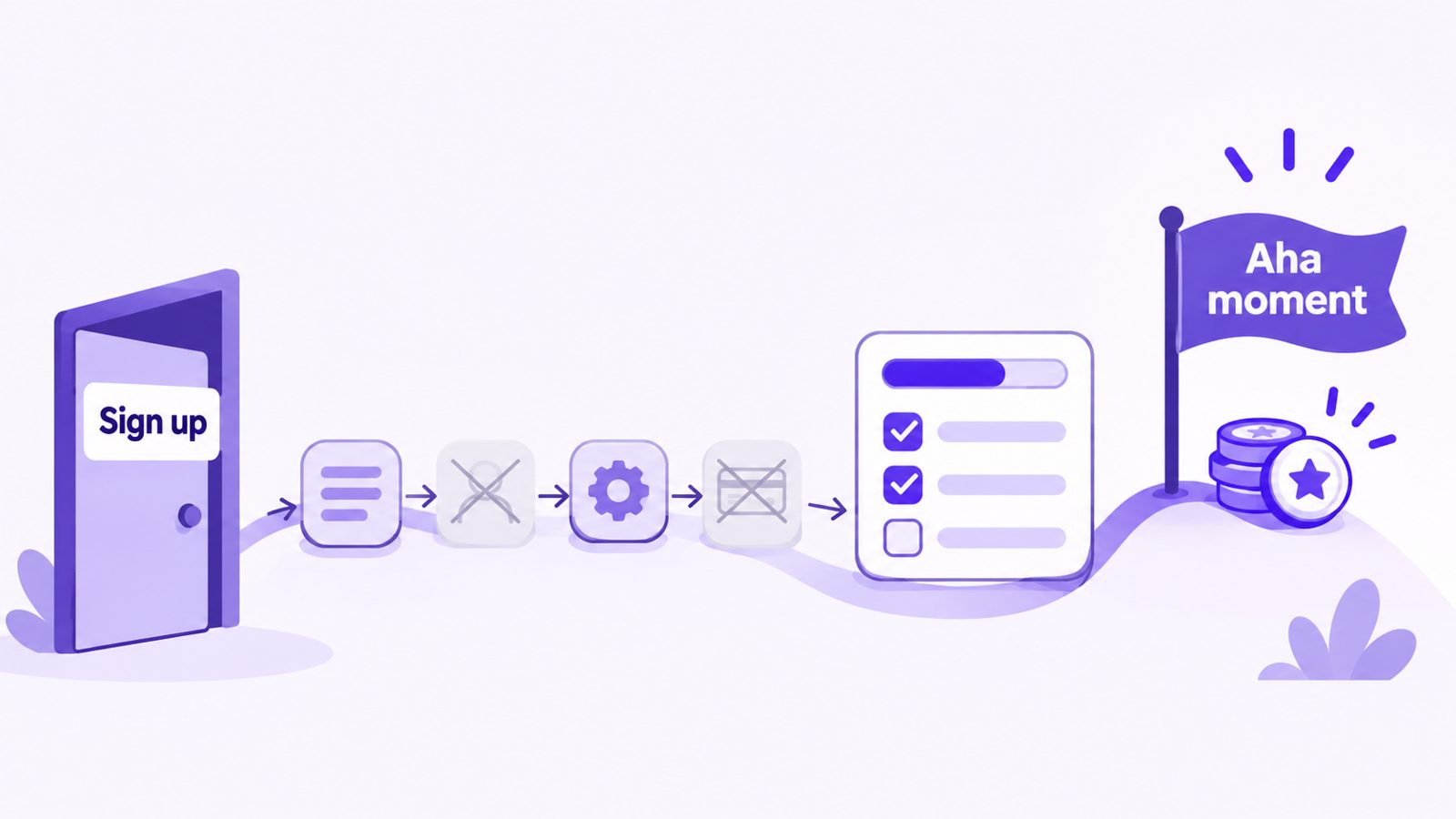
AI-generated illustration.
1. Pick one aha milestone
Everything else depends on this, so do it first. Activation measures users who hit an aha moment during onboarding, so your job is to decide which single action counts for your product. Define what "activated" means, then track the share of new users reaching it.
Good milestones are things the user does, not things you show them: the first report sent, the first integration connected, the first teammate invited. Whatever you pick must be reachable fast — Navattic's guidance for most product-led SaaS is that the aha action should be reachable in two weeks or less. Shorter is better.
If you track several milestones today, keep them for diagnostics, but crown one as the activation event. One number, one definition, written down where the whole team can see it.
2. Measure time to value, not just the rate
The rate tells you how many; time to value tells you how hard. In a ProductLed case study, Routific measured its time to value at a median of 75 minutes but an average of 12 hours spread across multiple sessions.
That gap between median and average is the useful part. It means half of users got there within 75 minutes while a long tail needed session after session. If your median and average are far apart, look for a group of users getting stuck somewhere specific. Measure both numbers before you touch anything else, because the fix for "slow for everyone" is different from the fix for "fast for most, broken for some."
3. Map the path and find the biggest drop-off
Routific's next move was to map the end-to-end journey to first value, listing the friction points at each step. Do the same: write down every screen, form, email, and wait between signup and your milestone, then put a conversion number on each step so you can see where people leave.
The step with the biggest drop-off is where you work first. ProductLed's takeaway is that activation improves fastest by shortening time to value and removing onboarding friction — and the map shows you where the friction actually lives, rather than where you assume it lives.
4. Cut steps that don't lead to the milestone
Now delete. Navattic, citing OpenView, recommends keeping an onboarding list to 10 steps or fewer, and most signup flows can lose steps without losing anything that matters.
Three cuts that usually work:
- Defer profile fields that aren't needed for the milestone. Company size can wait; value can't.
- Offer sample data so users see the product working before they connect anything real.
- Make integrations optional until later. Navattic notes integrations are often the key blocker to seeing value in a trial — so either make the first one very easy or move it off the critical path.
For every step you keep, ask one question: does the user need this to reach the milestone, or do we want it for our own database?
5. Guide what's left with a short checklist and progress
The steps that survive need guidance. Chameleon recommends proactive help — live chat, guided sign-up forms, and an onboarding checklist (Chameleon).
In a Userpilot case study, Sked Social used a four-task checklist with a progress bar, and users who completed it converted at 3x the rate of those who didn't. Read that carefully before you celebrate: completers self-select. People who finish a checklist tend to be the more motivated users anyway, so this is correlation, not proof the checklist caused the conversions. A checklist guides intent; it doesn't create it.
Keep the list short (Sked Social used four tasks), order it toward the milestone, and show progress so users know how far they've got.
6. Reward completion with your own product credits
Guidance tells users what to do; a reward gives them a reason to do it today. The mechanism: grant credits in your own product's unit — days of a paid plan, an extra seat, usage credits — when a user finishes an action you chose. Neutral examples: finish setup, invite a teammate, give feedback. Three rules keep it healthy: each action pays once, there's a cap per account, and every rewarded action happens inside your own product.
That last rule matters. Don't reward actions on platforms whose rules ban incentives: GitHub's Acceptable Use Policy bans activity incentivized by credits, and Trustpilot doesn't allow incentivized reviews. Reward actions inside your own product.
Disclosure: Stickly is my product. This is the use case it is built for: it's an engagement widget where you pick the actions, your users earn your own product credits, and a signed webhook grants the credits to your own ledger — see stickly.live.
7. Segment milestones by user type
One milestone can be the wrong milestone for part of your user base. Chameleon advises tailoring milestones to segments — by role, by use case, or by plan.
The benchmark spread shows why one number never fits everyone: in the same Userpilot report, AI/ML products averaged 54.8% activation while FinTech averaged 5%. Products differ in how fast value arrives, and user types inside one product differ the same way. An admin who needs to configure the workspace and a teammate who needs to complete one task may each need their own milestone and their own checklist. Define "activated" per segment and track both numbers separately, or the average hides the problem.
8. Measure weekly cohorts and change one thing at a time
Now the measurement discipline. Group signups by the week they joined, compute each cohort's activation rate — activated users ÷ total signups × 100 — and compare cohorts as you ship fixes. Change one thing per week, or you won't know what worked.
Give changes time to show up. In the ProductLed case study, Routific's trial activation rose from around 40% to over 70% between March 2019 and April 2020, while average time to activate fell by over 60%. That took about thirteen months, so judge a fix on several cohorts, not one week. Your weekly cohort table is what tells you you're on the same path.
Activation is the front half of retention: once a cohort reaches the milestone, the next number to watch is how many of those users stay. Our guide to churn rate covers the customer and revenue churn formulas, with worked examples.
A worked example
Hypothetical numbers, to show the arithmetic: say 200 people sign up this week and 50 of them reach your milestone. Activated users ÷ total signups × 100 = 50 ÷ 200 × 100 = 25%. That matches the 25% median in the Lenny Rachitsky survey cited by Navattic — neither bad nor good, just the middle of the pack.
Now suppose you cut two setup steps and add a checklist, and a later cohort of 200 signups produces 60 activated users. That's 60 ÷ 200 × 100 = 30%. Same traffic, ten more people reaching value. Run that same arithmetic every week against the same milestone and the same signup window, and you always know whether a fix actually worked or just shipped.
Common mistakes
Three ways teams fool themselves:
- Counting checklist completion as activation. The checklist is scaffolding; the milestone is value. Finishing four tasks means nothing if none of them is your aha action. And remember the Sked Social caveat: completers self-select, so completion-to-conversion is correlation, not proof.
- Rewarding actions on platforms that ban incentives. GitHub's Acceptable Use Policy bans activity incentivized by credits, and Trustpilot doesn't allow incentivized reviews. Keep rewards inside your own product, for actions you control.
- Changing several things in one week. If the rate moves, you can't attribute it; if it doesn't, you can't tell which change failed. One fix, one cohort, one comparison.
The order matters more than the list: define the milestone, shorten the path to it, then guide and reward the walk. If one of your milestones or rewards involves users inviting teammates, the follow-up read is how to pick referral program software.
I'm Tarun, founder of Stickly.
FAQ
What is a good SaaS activation rate?
Published vendor benchmarks put it roughly between 25% and 37.5%: a Lenny Rachitsky survey cited by Navattic found a 25% median and 34% average, and Userpilot's 2025 report of 62 companies found a 37.5% average. Your own week-over-week trend matters more.
How do you calculate activation rate?
Divide the users who reached your activation milestone by total signups in the same period and multiply by 100. Fifty activated users out of 200 signups is 25%.
How fast should users reach the aha moment?
Navattic's guidance for most product-led SaaS is two weeks or less, and faster is better. Measure both the median and the average time to value; a large gap means a group of users is getting stuck.
Can I reward users for GitHub stars or Trustpilot reviews?
No. GitHub's Acceptable Use Policy bans activity incentivized by credits, and Trustpilot does not allow incentivized reviews. Reward actions inside your own product, such as finishing setup, inviting a teammate or giving feedback.