How to Get Your First 500 Users for a SaaS: 2-Stage Plan
Tarun · 16 November 2026 · 9 min read
Quick answer: to get your first 500 users for a SaaS, work in two stages. Recruit the first 100 by hand — your own network, direct outreach to people who match your ideal customer profile (ICP), and communities where you help before you pitch. Then grow from 100 to 500 with channels that repeat: launch boards and directories, referrals from happy users, and a few focused landing pages. Fix activation and retention before you add volume, because every new channel leaks through the same onboarding. My recommendation: hold off on paid ads and long SEO bets until the first 100 stay.
Two terms used below: activation means a new user reaches the product's core value for the first time; retention means they keep coming back in the weeks after.
This guide is for a solo or indie founder with a live product, a handful of users, and no growth team. You get an ordered list of channels from zero to 500 users, what to measure at each step, and what to skip for now.
How to get your first 500 users for a SaaS: the two stages
Why split at 100? Because of Graham's growth math: at 100 users, you need 10 more next week to grow 10% a week, and 10% weekly growth compounds to about 14,000 users after a year. The first 100 are the manual part. After that, growth is arithmetic — hold a weekly rate and compounding does the work. So the 500-user goal breaks into two stages with different jobs and different measures. (The 100-plus-400 split is an example to plan around, not data.)
| Stage | Goal | Main channels | What to measure |
|---|---|---|---|
| 1 (0–100) | Win users one at a time | Network filtered by ICP, direct outreach, communities | Activation: do new users reach the core value? |
| 2 (100–500) | Add repeatable acquisition | Launch boards and directories, referrals, landing pages and content | Retention, referral rate, weekly growth |
In Do Things That Don't Scale, Graham argues for recruiting users manually at the start. The channels in stage two only pay off if stage one taught you who your user is and why they stay. Note the last column of the table: each stage has its own measure, and both come before channel volume.
Stage 1 (0–100): recruit users by hand
Stage one is unscalable by design. You are not looking for a channel; you are looking for individuals who have the problem you solve, one conversation at a time. Graham's instruction to recruit users manually comes with a standard for how far to go. When someone agreed to try Stripe, the founders said "give me your laptop" and set them up on the spot — the "Collison installation." That is the bar: remove every step between a yes and a person actually using the product.
The experience has to match the effort. Graham says your first users should feel that signing up was one of the best choices they ever made. And Lenny Rachitsky explains why the manual approach wins: none of these early strategies scale, and that is exactly why they work — trust is the key to winning first customers.
Your network, filtered by your ICP
Rachitsky's sequence for the first B2B customers, laid out in his guide to winning your first 10 B2B customers, starts with your personal network — filtered to people who match your ICP — then moves to strategic cold outbound, your investors' networks, and then relevant communities (the sequence moves outward from the highest-trust channels).
Work it in order. Write your ICP in one sentence ("early-stage B2B founders who…"). Then go through your contacts, former colleagues, and LinkedIn connections and list everyone who fits. Message them one by one — a personal note about the problem, not a launch announcement. When someone becomes a happy user, ask for one introduction to a peer. Ten real conversations beat a hundred impressions at this stage.
Direct outreach to people with the problem
Cold outbound is the second step in the sequence, and it works — Rachitsky's caveat is that it has to be done creatively, not as a generic blast. Paddle calls outbound free, proven, and capable of generating quick results, and cites Lemlist growing to over 10,000 customers with outbound emails (company-reported).
Start with a list of businesses that match your ICP — a lead-finding tool such as Mantis lead finder can speed up building that list. Then write short emails about their problem, not your product: one specific observation, one question, one low-friction ask. When someone agrees to try, do your own Collison installation and set them up yourself on a call. The goal of each message is a conversation, not a signup.
Communities: help first, link later
Communities work on a delay. Rachitsky's rule: add value first, because no one pays attention if you are only there to pitch. The effort involved is real — Paddle notes that DesignJoy's founder posted thousands of high-quality comments on Indie Hackers. Respect each platform's norms as you go: Reddit's rules ask you to participate authentically in communities where you have a personal interest, and not to spam.
Pick two or three communities where your ICP asks questions. Answer questions thoroughly for a few weeks before your product comes up at all. When it does come up, it should be because it genuinely answers someone's question.
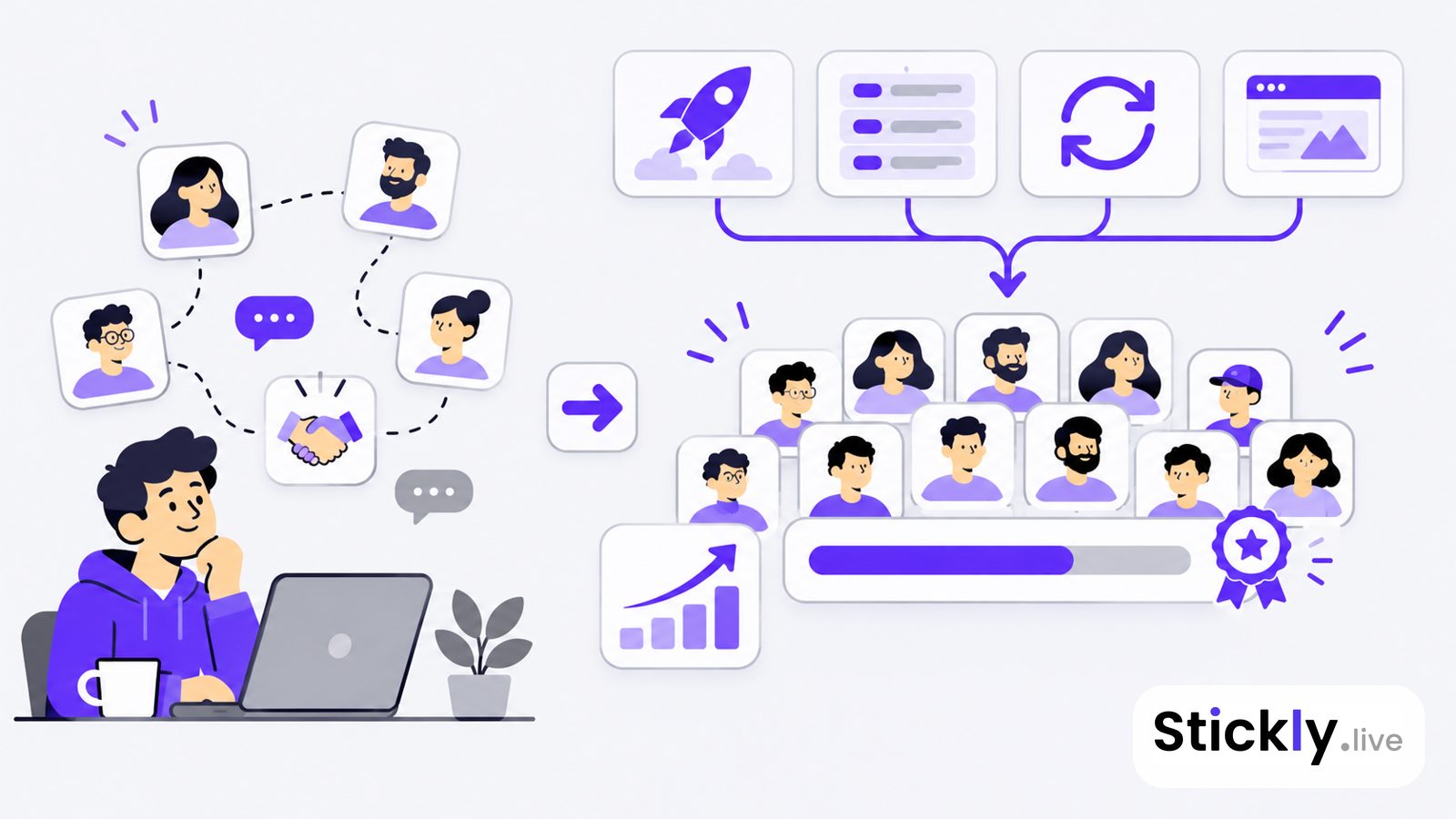
AI-generated illustration.
Stage 2 (100–500): channels that repeat
With 100 users who stay, you can add channels that bring users without a personal message each time. One self-reported data point on the mix: the founder of PlusVibe (pipl.ai) reported a bit over 500 sign-ups in 30 days, focusing on directories — G2, Product Hunt, AppSumo, BetaList, Startups.fyi, SaaSHub, Serchen and Launched! — plus Twitter, LinkedIn, Reddit, a Facebook community and cold emails. Treat that as one founder's channel map, not a promise of results; its value is showing which doors exist.
Launch boards and directories
The PlusVibe list above is a practical starting set: launch boards (Product Hunt, BetaList, Launched!), review and comparison directories (G2, SaaSHub, Serchen), and deal marketplaces (AppSumo). Three working rules:
- Stagger submissions — roughly one a week — so you can reply to every comment and fix what new users trip over.
- Prepare each listing like a landing page: clear first screenshot, one sentence of value, one call to action.
- Follow platform rules. Product Hunt's guidelines forbid asking for upvotes, incentivizing upvotes, and mass messaging. Breaking them risks the listing and the reputation you came to build.
Referrals and rewards inside your own product
The cheapest users to acquire are the ones your current users bring. Build the referral path into the product itself rather than bolting on a campaign. Stickly (disclosure: I'm the founder) is an engagement widget for exactly this: founders reward their own users with their own product credits for actions they choose — finish onboarding, invite a teammate, give feedback, or a custom link — and a signed webhook grants the credits.
Keep the rewarded actions inside your own product: inviting a teammate, finishing onboarding, sending feedback. Do not reward actions on third-party platforms — credits for reviews, stars, or upvotes break those platforms' rules and buy you noise instead of users. For setup options and mechanics, see our guide to referral program software.
Focused landing pages and content
Content is a legitimate early-users channel: Rachitsky found that a surprising number of founders landed early customers by publishing compelling content and building a following. Search, though, is a patience game — Paddle describes SEO as not a quick win, with gains that compound over time. So publish early, aim each piece at a specific problem your ICP has, and don't expect it to carry the first 100.
Because every channel in this article eventually lands on a page of yours, that page is where acquisition is won or lost. Paddle's warning is blunt: without landing page optimization, marketing time and money are lost at the most critical moment. Keep it simple: one page per use case or audience, one promise, one call to action, and as few fields as possible between the visitor and the product.
Fix activation and retention before you add volume
Every channel above ends in the same place: your onboarding. If new sign-ups stall before they reach the product's core value, more volume just means more people leaving. ProductLed's finding is that activation improves fastest when you shorten time-to-value by removing onboarding friction. Graham's standard for early users — signing up should feel like one of the best choices they ever made — is an activation target, not a slogan.
Practically: watch where this week's new users stopped, cut one step between signup and first value, and measure whether cohorts keep coming back. Two deeper reads on this blog: how to improve your SaaS activation rate and how to think about churn rate.
What not to do yet
- Paid ads before retention is proven. My view: if the first 100 don't stay, paid traffic mostly buys you faster churn. Earn the spend by fixing activation first.
- SEO as your only channel. It compounds, which makes it a good side bet and a bad plan for the next quarter.
- PR as a plan. Rachitsky's assessment: PR can work, but it rarely does. If a story lands, take the spike; don't build the quarter around it.
- Buying or incentivizing upvotes. Product Hunt explicitly forbids it, along with upvote requests and mass messaging — and the same logic applies to paying for reviews or stars anywhere else. Short-term bump, long-term damage.
A simple weekly plan
Anchor the week to Graham's math: at 100 users, 10 new users in a week is 10% growth — the pace that compounds to roughly 14,000 in a year. Before 100, a fixed weekly user target does the same job: it keeps manual recruitment from slipping when product work feels more urgent. A workable week:
- <input /> Write or refine your one-sentence ICP; every task below targets it
- <input /> Message people from your network who match the ICP — individual notes, no blasts
- <input /> Send a batch of short, specific cold emails to businesses on your target list
- <input /> Onboard at least two new users yourself, live, Collison-style
- <input /> Post useful answers in your two or three communities — no pitch
- <input /> Submit to one directory or launch board; reply to every comment
- <input /> Ask each active user for one introduction; keep referral credits running
- <input /> Ship one improvement to your highest-traffic landing page
- <input /> Find where this week's sign-ups stalled in onboarding; remove one friction point
- <input /> Count activated users at week's end — not just sign-ups
I'm Tarun, founder of Stickly, the engagement widget mentioned in the referrals section.
FAQ
What is the fastest way to get your first 100 SaaS users?
Recruit them by hand: your personal network filtered by your ICP, creative cold outbound, and communities where you help before you pitch. None of these strategies scale, which is why they work — trust is the key to winning first customers.
Do cold emails actually work for early users?
They can. Cold outbound works when done creatively rather than blasted, and Paddle calls outbound free, proven, and capable of quick results, citing Lemlist growing to over 10,000 customers with outbound emails (company-reported).
Should I launch on Product Hunt to get early users for my startup?
Yes, as a stage-two channel once onboarding holds. One founder self-reported a bit over 500 sign-ups in 30 days from a mix focused on directories (Product Hunt among them) plus social posts and cold email. Follow the rules: Product Hunt forbids asking for upvotes, incentivizing upvotes, and mass messaging.
When should a SaaS start investing in SEO?
Early, but small. SEO is not a quick win, though the gains compound over time. Publish focused pages from the start, but do not rely on search for the first 100 users.
What should I fix before spending on acquisition?
Activation and retention. Activation improves fastest when you shorten time-to-value by removing onboarding friction — and every new channel leaks through the same onboarding.